


Many folks around these parts have heard of Trapper Nelson. But legend and reality aren’t always the same thing. Let’s take a look at the man who was already larger than life in his own time, living not just on the line between Martin and Palm Beach counties but on the fault line between civilization and the frontier.
Born Vincent Natulkiewicz to immigrant parents (and later known as Vince Nelson and then Trapper Nelson), he left Trenton, New Jersey for a roaming life of hunting and trapping—first out West, then in Florida. That life turned dark when Charlie, Vince’s older brother, fatally shot their trapping partner over a petty dispute. Charlie was sent to the state penitentiary for murder. In 1933, Vince landed on the Loxahatchee River’s Northwest Fork and began building something of his own—piece by piece—from salvaged materials, palm fronds, and pine logs he cut himself. By the 1940s, the rough camp had taken shape with two sturdy log cabins.
Vince came looking for solitude: a quiet life trapping animals for their fur or to sell to zoos. Instead, he became the attraction himself. At 6 foot-2 inches tall and 215 pounds of muscle, Vince’s imposing presence—and bare-chested, barefoot routine—drew curious visitors. The Johnny Weissmuller Tarzan films were filling movie theaters at the time, and here was a man who looked like he’d stepped right off the silver screen.

Vince leaned into it. Though he had little formal education, he had a sharp business sense. He charged admission to guests wanting to picnic at his camp and gawk at his animals. Sometimes he draped a large indigo snake over his shoulders. Early on, he even wore furs to heighten the wildman image. Word spread fast—from Jupiter locals to tourists to the wealthy enclaves of Jupiter Island and Palm Beach. Even John F. Kennedy visited as a teenager. Though Vince could be a gracious host, he had little patience for disrespect—and bristled at anyone who treated him like a spectacle.
By 1960, the spectacle wore thin. Rowdy teenagers, careless tourists, and persistent health inspectors pushed Vince to close his camp to the public. Family and close friends still visited, and he continued trips into the growing town of Jupiter for mail and supplies. But the world was closing in. Vince had amassed more than a thousand acres of land, yet he worried about what would become of it. As Jupiter and Tequesta expanded, roads and canals began carving up the landscape. At the same time, his health declined. He feared cancer—but even more, he feared losing the independence that had always defined him.
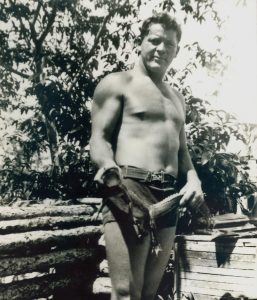
On July 30, 1968, Vince missed an appointment in town. His friend, John DuBois, went to check on him and found him dead. He was not quite 60 years old when a shotgun slug pierced his chest and stopped heart. Suicide? An accident? Or something darker—the jealous husband of a local woman, a greedy developer eyeing riverfront property? The questions lingered. The answers have still never come.
What remained was his land. The Florida Park Service negotiated a land swap with Vince’s estate and the developers of Jupiter Hills Country Club, preserving the heart of his domain. Today, Jonathan Dickinson State Park protects Trapper’s Zoo & Jungle Gardens as a singular historic site. His riverfront acres became a key stretch of Florida’s first National Wild and Scenic River—proof that, in the end, the wilderness he fought to hold onto still tells his story.
Josh Liller is the historian and collections manager for the Loxahatchee River Historical Society, a 501(c)(3) nonprofit that operates Jupiter Inlet Lighthouse & Museum. All photos accompanying this article are courtesy of Martin Digital History.







Facebook Comments